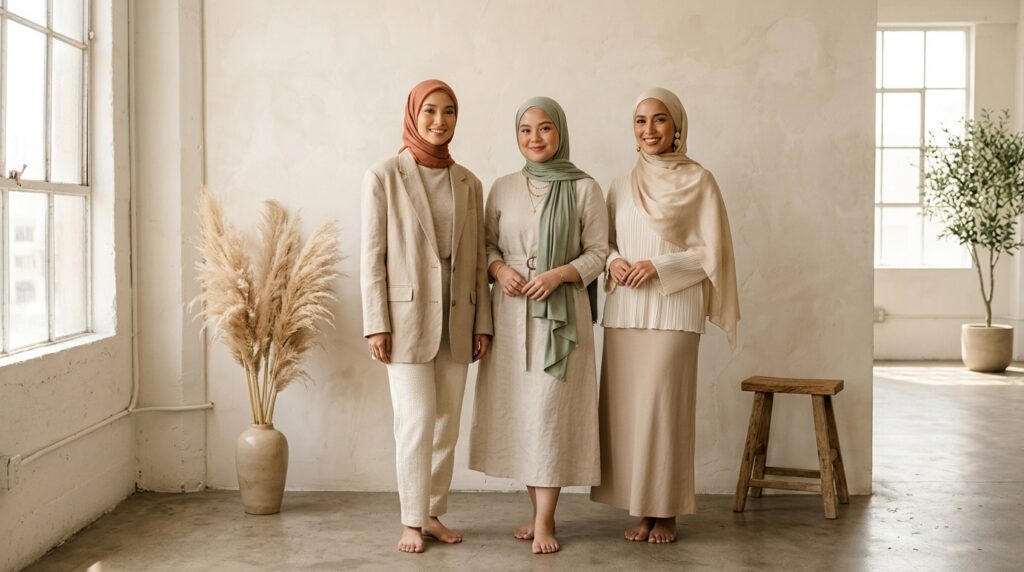
Your online shopping cart is probably full of hijabs that looked effortless on the studio catalog model. Then the parcel arrives, you wrap it in front of the bathroom mirror, and something feels off. Your cheeks look twice as wide, your jawline looks boxy, or the fabric balloons around the crown of your head like a helmet.
Color is rarely the culprit. Roughly 90% of bad hijab purchases happen because shoppers pick a shade from a product thumbnail while ignoring the three physical specs that actually control facial proportions: forehead awning stiffness, fabric drape weight (GSM), and cut dimensions. Wrap a 170×60 cm high-gloss satin pashmina tightly around a round face, and it will emphasize every curve of the cheek no matter how expensive the brand is.
Before you hit checkout on another stack of scarves, match your bone structure to the exact fabric weave, hem finish, and dimensions listed in the product description.
How to Measure Your Face Shape in Front of a Mirror in 30 Seconds
Never judge your face shape from a front-facing phone selfie. At arm’s length, a smartphone’s wide-angle lens distorts the center of your face and narrows your temples by up to 15%, convincing almost everyone that they have a long or oval face.
Stand an arm’s length away from a flat wall mirror with your hair tied back and compare three horizontal widths: your forehead across the arches of your eyebrows, the outer edges of your cheekbones, and the corners of your lower jaw. Then compare those widths against your vertical length from hairline to chin tip.
If your vertical length and cheekbone width are nearly equal with a soft, curved chin, you have a round face. If your forehead, cheekbones, and jaw are almost the same width with sharp corners below the ears, you have a square face. A broad forehead and temples that taper down to a narrow, pointed chin mark a heart-shaped (inverted triangle) face. When vertical length noticeably exceeds cheekbone width, you have an oblong (long) face. And if your face length is roughly 1.5 times your cheekbone width with a softly rounded jaw, you have an oval face.
| Face Shape | Key Proportions | Best Hijab Fabrics & Cuts to Buy | Fabrics & Styling Details to Skip |
|---|---|---|---|
| Round (Full Cheeks) | Face length nearly equals cheekbone width; soft, rounded chin | 60s–80s Ultrafine Voile squares (115×115 cm) for a structured pointed awning; matte Ceruty Babydoll or Bamboo Jersey pashminas (180×75 cm) | High-shine Satin Silk, stiff Organza, tight undercaps pulled behind the cheekbones, and metallic shimmer finishes |
| Square (Strong Jawline) | Forehead, cheekbones, and jaw are equal width; angular jaw corners | Modal Viscose, Tencel Rayon, or Crinkle Silk pashminas with a fluid drape that skims softly past the jaw | Starched traditional Paris cotton, thick Watersplash Voile folded into sharp side triangles at the jaw, and tight neck wraps |
| Heart (Inverted Triangle) | Wide forehead and temples tapering to a narrow, delicate chin | Tryspan Voile or Fine Polycotton squares (120×120 cm) draped wide across the collarbones to balance the lower face | Oversized volumizing scrunchies (cepol) at the crown and heavy pleated folds stacked right at the temples |
| Oblong (Long) | Vertical forehead-to-chin length is much greater than cheekbone width | 2-in-1 Built-in Inner Pashminas or Rayon Jersey worn with a visible headband undercap covering 1.5 cm of the upper forehead | High pointed awnings above the hairline and long, unpinned pashmina tails hanging straight down the torso |
| Oval | Length is ~1.5× width; balanced forehead and curved jawline | Almost any weave: Premium Paris, Arabian Voile, Textured Silk, or Modal Jersey | Paper-thin spandex jersey below 120 GSM pulled too tightly under the chin, which drags the mid-face downward |
1. Round Faces and Full Cheeks: Look for Structured Forehead Awnings and Matte Weaves
The goal for a round face is straightforward. You want to add vertical height at the top of the head while casting a subtle shadow along the outer edges of your cheekbones.
When shopping for square scarves (segi empat), look for Ultrafine Cotton Voile (60s to 80s thread count) or authentic Japanese Paris Voile. These weaves have enough natural body to hold a gentle pointed arch (lancip) at the center of the forehead without needing starch spray. Place the peak of that arch about one centimeter above your natural hairline to lengthen your profile. Along the sides, bring the fabric slightly forward so it covers the outer centimeter of your cheekbones before pinning it beneath your chin.
If you prefer pashminas, the biggest mistake is buying thin, clingy spandex that hugs the contour of your cheeks, or glossy satin silk that reflects overhead light right along your jaw. Specular shine visually expands any surface it touches. Swap shiny fabrics for a pebble-textured Ceruty Babydoll Chiffon or a Bamboo Viscose Pashmina with a dead-matte finish.
Pay attention to color depth in the product options, too. Deep, saturated shades like espresso, charcoal, midnight navy, and oxblood act like natural contour along the sides of the face, whereas stark white or icy pastel satin widens the cheeks.
2. Square Faces: Soften Angular Jawlines with Fluid, Rounded Drapes
A square face comes with a strong, photogenic jawline, but the wrong fabric stiffness makes that bone structure look rigid and severe. Straight lines and crisp, origami-like folds right next to the ears are your worst enemies here.
Cross stiff fabrics off your shopping list—especially organza, crisp cotton poplin, and heavy budget voile finished with a thick rolled hem (neci). When a stiff fabric bends around your cheek, it forms a sharp triangular crease right at the mandibular angle, doubling down on the boxiness of your jaw.
Spend your budget on textiles with high fluid drape. Tencel Modal Pashminas, Premium Rayon, and Crinkle Silk Chiffon work best because their fibers fall in soft, continuous curves rather than sharp corners. When styling, skip the side-temple crease entirely. Let the top edge curve naturally around your forehead (rounded awning), pin it loosely under the chin, and allow the loose ends to cascade in soft folds over the corners of your jaw and collarbone.
One extra adjustment if you love a neat, tucked-in office look: instead of wrapping both ends tightly around your neck, leave one panel draped loosely across the front of your shoulder to break up the symmetry around your jaw.
3. Heart-Shaped Faces: Shift Fabric Volume Down to the Collarbones
Heart-shaped faces carry their width across the forehead and temples before tapering down to a small, pointed chin. The trap when buying hijabs and accessories for this shape is adding even more bulk to the top half of your head.
When browsing undercaps (ciput) and volumizers, skip the jumbo tulle scrunchies and high-crown bun shapers. Stacking height at the back of the crown makes a wide forehead look top-heavy. Stick to a flat stitch-free rayon headband or a plain jersey undercap that sits flush against your skull.
For the hijab itself, buy Tryspan Voile or Fine Polycotton squares in an oversized 115×115 cm or 120×120 cm cut. Why does that extra five to ten centimeters matter? Because you need enough fabric length to create visual weight across your neck, shoulders, and chest. Fold the side edges slightly inward to narrow the outer temples, and leave a one-finger gap when pinning the fabric beneath your chin. Never cinch a pin tightly right against a narrow chin. Letting the scarf drape generously around your collarbones fills out the lower third of your silhouette so your forehead and chin look balanced.
4. Oblong (Long) Faces: Break the Vertical Line with Undercaps and Horizontal Wraps
Where a round face needs extra height at the crown, an oblong face needs the exact opposite: you want to shorten the vertical forehead-to-chin line and add horizontal width across the cheekbones.
Stay away from stiff square scarves that peak high above the forehead, and avoid wearing long pashminas with both ends hanging straight down to your waist. Two unbroken vertical columns of fabric framing your face draw the eye downward and make a long face look gaunt.
The smartest buy for an oblong face is a 2-in-1 Built-in Undercap Pashmina or a soft Rayon Jersey / Ceruty Pashmina paired with a matching headband inner. Pull the undercap slightly down so it covers the top 1.5 to 2 centimeters of your forehead. That single horizontal line cuts excess vertical length immediately.
Look for soft, pliable fabrics that tuck comfortably behind the ears (ear-tuck style). Exposing the full curve of your cheekbones and wrapping the remaining fabric horizontally around your neck adds welcome width right across the middle third of your face.
5. Oval Faces: Experiment Freely, But Watch Out for Low-GSM Jersey
An oval face has balanced proportions that flatter almost every hijab cut, from a classic knotted Premium Paris square to a draped Turkish pashmina. Still, balanced bone structure won’t save a bad textile.
The most common regret for oval-faced shoppers buying online is falling for ultra-cheap jersey pashminas made from thin synthetic spandex under 120 GSM. Cheap, heavy spandex pulls downward under its own weight, flattening the fabric against your temples and dragging the visual center of your face down. If you want an effortless, unpinned meleyot pashmina look, check the product specs for Bamboo Cotton Rayon or Tencel Modal Spandex in the 140–160 GSM range. It holds gentle volume around the crown without clinging to your scalp.
Four Online Product Specs to Check Before You Hit Checkout
Studio catalog photos rely on ring lights, industrial steamers, and half a dozen hidden clips behind the model’s back. To know how a hijab will actually behave on your face, check these four technical details in the seller’s description:
- Actual Cut Dimensions (Skip Undersized Scarves): For square hijabs, avoid budget 105×105 cm or 110×110 cm cuts if you have a round, square, or heart-shaped face—the corners are too short to frame your jaw and cover your chest without pulling tight. Look for 115×115 cm or 120×120 cm. For pashminas, insist on 180×75 cm; narrow 170×60 cm cuts constantly slip off the back of the neck when wrapped.
- Edge Hem Finish (Lasercut vs. Micro-Hem vs. Rolled Neci): How the factory finishes the border changes how the scarf sits against your cheeks. A micro-sewn hem (jahit tepi kecil) gives the cleanest, most durable structure for a pointed forehead awning. A heat-sealed lasercut edge lies completely flat against a square jaw without adding bulk, provided the fabric isn’t a loose weave that frays in the wash. Avoid thick rolled overlock hems (neci/wolsum) on lightweight fabrics, which tend to ripple into wavy lettuce edges right beside your cheekbones.
- Weave Opacity and Undercap Friction: Single-layer Paris cotton and Ceruty chiffon are semi-sheer in daylight. If you have a round or square face and need a full-coverage undercap underneath, make sure the two fabrics don’t fight each other. A breathable rayon-cotton undercap grips both ultrafine voile and pebble ceruty without sliding backward by midday.
- Skin Undertone Contrast: Even the right awning geometry looks tired if the fabric color clashes with your skin’s undertone. Most Southeast Asian complexions lean warm or neutral-olive. Earthy tones like terracotta, warm oatmeal, olive green, taupe, and rich mocha bounce warmth back onto your cheekbones, while icy pastel grey or neon lilac can cast an ashy shadow under the eyes.
Before buying another scarf tonight, pull out the one hijab sitting at the back of your drawer that always felt unflattering. Check its fabric weight and dimensions, adjust where the fold sits on your forehead by a single centimeter, and move your chin pin slightly forward or back to match your face shape.