Forty-five minutes into a heavy autumn downpour, almost every $150 “waterproof breathable” jacket starts feeling clammy inside. Most people assume the membrane is leaking. It usually isn’t. What actually happened is simpler and much more frustrating: the outer face fabric absorbed water, formed a continuous liquid film over the microscopic pores, and dropped the jacket’s vapor transmission rate to nearly zero. You are sweating inside a plastic bag.
Rainwear marketing hides basic physics behind trademarked acronyms and hangtags. If you want a raincoat that actually keeps you dry, you have to ignore the “100% waterproof” label on the rack and look at three distinct components: the outer face fabric, the waterproofing barrier (membrane or coating), and how the layers are bonded together.
The Two Numbers on the Spec Sheet (And How Brands Game Them)
Before comparing fabrics like nylon, polyurethane, or Gore-Tex, you need to know how labs measure water resistance and breathability.
Hydrostatic Head (HH) measures how tall a column of water (in millimeters) a fabric can support over a 1-inch tube before three drops leak through. Technically, fabric only needs 1,500mm to be legally sold as “waterproof” in many markets. That is a joke in the real world. Kneeling on wet grass exerts around 12,000mm of pressure, and heavy backpack straps pushing rain into your shoulders easily pass 15,000mm. For a jacket that won’t leak when you lean against a wet railing or carry a commuter bag, treat 10,000mm as the real-world floor and 20,000mm+ as serious storm protection.
MVTR (Moisture Vapor Transmission Rate) measures how many grams of water vapor can pass through a square meter of fabric in 24 hours (g/m2/24h). A rating of 10,000 g/m2/24h works for walking the dog. Uphill hiking or cycling in the rain demands 20,000 g/m2/24h or higher, plus physical pit zips because no membrane on earth moves moisture fast enough once your heart rate passes 130 bpm.
1. Non-Breathable Coated Fabrics: PVC, PU, and Silicone
Sometimes the best raincoat doesn’t breathe at all.
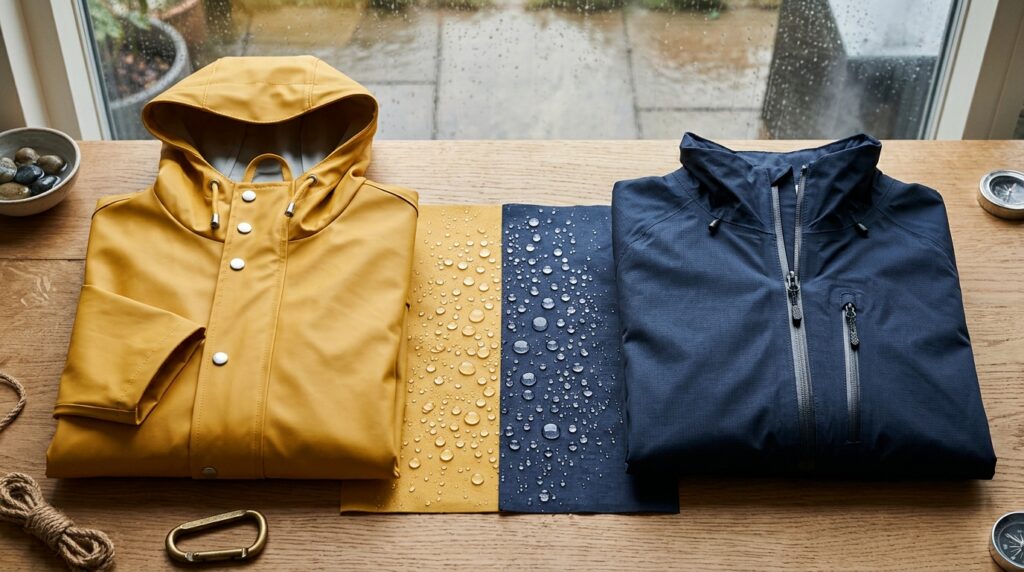
Traditional yellow fisherman slickers and European commuter coats (like Rains or Helly Hansen Moss) use a woven polyester or cotton-blend base coated with a thick layer of Polyurethane (PU) or Polyvinyl Chloride (PVC). Water cannot get through them. Period. They don’t rely on delicate chemical coatings to shed water, they never delaminate from sweat oils, and you can hose mud straight off them without ruining the fabric.
| Material Type | Typical Hydrostatic Head | Breathability (MVTR) | Lifespan | Best Real-World Use |
|---|---|---|---|---|
| PVC / Heavy PU Slicker | 25,000mm+ (Effectively infinite) | 0 g/m2/24h | 8–15 years | Scooter commuting, fishing, standing in heavy rain, casual city walks |
| Silpoly / Silnylon | 1,500mm – 4,000mm | 0 g/m2/24h | 5–10 years | Ultralight backpacking ponchos and packable emergency shells |
| 2.5-Layer PU Microporous | 10,000mm – 15,000mm | 10,000 – 15,000 g/m2/24h | 2–4 years | Budget rain shells kept at the bottom of a daypack |
| 3-Layer ePTFE / ePE | 20,000mm – 28,000mm+ | 15,000 – 25,000+ g/m2/24h | 6–12 years | Active hiking, cycling, daily heavy-duty rain wear |
If you ride a motorcycle, stand on a sidelines bench, or walk 15 minutes to the train station at a slow pace, buy a welded-seam PU raincoat. You aren’t generating enough body heat to push vapor through a breathable membrane anyway. Just watch out for cheap PVC: it cracks in freezing temperatures and weighs a ton. Welded tricot-backed PU stays supple in the cold and weighs half as much.
Another non-breathable contender is Silpoly (silicone-impregnated polyester). Ultralight hikers love it because a full rain jacket weighs 140 grams, packs into the size of an apple, and never “wets out” the way coated nylon does. You rely entirely on huge mechanical vents (pit zips or a poncho cut) for airflow.
2. Microporous Membranes: ePTFE, ePE, and Electrospun PU
When you move fast enough to sweat, you need a membrane stretched beneath an outer shell fabric.
For forty years, the gold standard was ePTFE (expanded Polytetrafluoroethylene), most famously used in classic Gore-Tex. Stretching Teflon creates a web of roughly 1.4 billion pores per square inch. Each pore is 20,000 times smaller than a liquid water droplet, but 700 times larger than a single water vapor molecule. Liquid rain stays out; steam from your skin escapes.
Since 2024, environmental regulations against forever chemicals (PFAS/PFCs) have forced outdoor brands to retire ePTFE in favor of ePE (expanded Polyethylene) and electrospun polyurethane membranes (like Pertex Shield Air or Patagonia’s H2No). Early PFAS-free jackets were stiff and wetted out easily. Current 3-layer ePE membranes match the 28,000mm waterproof ratings of old ePTFE while weighing less, though they have one catch you cannot ignore: skin oils and sunscreen clog polyethylene pores much faster. If you buy a modern ePE shell, you have to wash it every 10 to 12 days of active use with a residue-free technical detergent (like Nikwax Tech Wash), or the membrane will delaminate around the collar.
3. Face Fabrics: Nylon vs. Polyester (And Why Denier Matters)
The membrane is paper-thin and fragile, so manufacturers glue it to the underside of a woven face fabric. Usually, that outer shell is either nylon or polyester, measured in Denier (D), which is the weight in grams of 9,000 meters of yarn.
Ripstop Nylon (15D to 40D) dominates high-end hiking shells because it has exceptional tear strength and abrasion resistance for its weight. A 20D nylon jacket feels featherlight. It also has a hidden flaw: nylon is hydrophilic. Even with a water-repellent treatment, nylon fibers absorb up to 4% of their weight in water during prolonged storms, causing the fabric to sag and feel cold against your arms.
Polyester (50D to 150D) is naturally hydrophobic. It absorbs less than 0.4% of its weight in water, holds its shape when soaked, and resists UV degradation much better than nylon. It is slightly heavier for the same tear strength, which is why you see 75D polyester on workwear rain jackets and everyday urban shells where durability matters more than saving 80 grams in a backpack.
2-Layer vs. 2.5-Layer vs. 3-Layer Construction
How the sandwich is put together determines whether your coat lasts ten years or peels apart in your closet after two seasons.
2.5-Layer (2.5L) Shells are the most common trap in outdoor retail. Brands take a nylon face fabric, laminate a cheap polyurethane membrane to the inside, and print a raised carbon or ceramic pattern (“the half layer”) over the membrane to keep it from sticking to your skin. That explains why jackets like the classic entry-level rain shell cost $100 and pack down small. The problem is durability. Sweat, body oils, and friction rub that printed half-layer off within a few years. Once the raw membrane is exposed, it turns sticky and flakes off like sunburned skin.
2-Layer (2L) Shells skip the printed coating and hang a loose mesh or taffeta liner inside the jacket to protect the membrane. They are comfortable, quiet, and durable enough for daily commuting, though the hanging liner adds bulk and catches on fleece sleeves.
3-Layer (3L) Shells fuse the outer face fabric, the waterproof membrane, and a thin knitted tricot or micro-grid backer into one single piece of material. Nothing rubs directly against the membrane. A 3-layer shell feels slightly stiffer on the hanger, but it slides easily over midlayers, never gets that clammy plastic-wrap feel against bare forearms, and routinely survives a decade of hard use.
The DWR Problem: Why Modern Raincoats Need More Maintenance
Every breathable raincoat depends on DWR (Durable Water Repellent), a chemical finish applied to the outside threads so rain beads up and rolls off.
When the DWR wears off, the outer nylon or polyester soaks through (“wets out”). The jacket is still waterproof—water isn’t passing through the inner membrane—but two bad things happen immediately. First, breathability drops to zero because vapor cannot push through a sheet of cold water sitting on the shell. Second, that cold wet outer fabric presses against your body and conducts heat away from you 25 times faster than dry air. You feel freezing wet even though no rain leaked in.
Old C8 and C6 fluorocarbon DWR finishes shrugged off dirt, campfires, and cooking grease for years. Modern C0 (PFAS-free) DWR finishes are vastly better for groundwater, but dirt and skin oils flatten them fast. When water stops beading on your shoulders, don’t buy a new coat. Wash the jacket in pure liquid soap (never standard laundry detergent, which leaves hydrophilic surfactants behind) and tumble dry it on medium heat for 20 minutes to reactivate the DWR polymer chains.
So, Which Raincoat Material Should You Actually Buy?
Skip 2.5-layer jackets entirely unless you only need a 180-gram emergency shell that stays buried in your backpack 350 days a year. They feel clammy the moment it pours, and they peel apart after a few summers.
For city commuting, walking the dog, or riding a scooter, buy a welded-seam PU-coated polyester raincoat (or a heavy 2-layer polyester shell with a hanging taffeta liner). You will never have to reproof the DWR, it won’t wet out in a two-hour downpour, and it costs a third of the price of an alpine shell.
For active hiking, cycling, or humid climates, spend the money on a 3-layer shell with a 30D–40D nylon or 50D polyester face fabric and mechanical pit zips. Check the tag before you pay: make sure it lists a hydrostatic head of at least 20,000mm and physical underarm vents. When the humidity hits 95% during a summer storm, a 12-inch zipper under your arm dumps more heat in thirty seconds than the most expensive membrane on the planet can vent in an hour.